 .Click
ストロークパターンを変えてみよう Try Different Stroke Patterns Prueba distintos patrones de rasgueo
ストロークパターンで曲の雰囲気が変わる
コードが押さえられて、テンポに乗って弾けるようになったら、次はストロークパターンを変えてみましょう。同じコード進行でも、ストロークの細かさやリズムの組み合わせ方によって、曲の雰囲気がガラッと変わります。
4分音符(ダウンストロークだけ)
クリック1回につきダウンストローク1回。最もシンプルな形で、これまでの練習でもやってきた基本パターンです。ゆったりした雰囲気になります。
8分音符(ダウン+アップ)
クリック1回につき、ダウン→アップの2回ストローク。4分音符の倍の細かさになり、少しリズムが賑やかになります。ダウンとアップが均等な間隔になるよう意識してみましょう。
16分音符(ダウン→アップ→ダウン→アップ)
クリック1回につき4回ストローク。さらに細かいリズムになります。最初はゆっくりなテンポで、手の動きを均等に保つことを意識してみましょう。
混在パターン
1小節の中に4分音符・8分音符・16分音符を組み合わせると、リズムに抑揚が生まれます。例えば最初の2拍はダウンストロークだけ、後の2拍はダウン+アップ、といった具合です。このように変化をつけると演奏がより音楽的になります。
全音符・2分音符
逆に、4拍(全音符)や2拍(2分音符)かけてゆっくり1回鳴らすパターンもあります。コードをしっかり押さえて音をきれいに鳴らす練習にもなります。
楽譜を見ながら試してみよう:4分・8分・16分
B.Clickのサンプル楽譜にstroke_4-8-16_note.pdfという練習用楽譜があります。4分音符・8分音符・16分音符のストロークが順番に並んでいて、↓(ダウン)・↑(アップ)の矢印で弾き方が示されています。
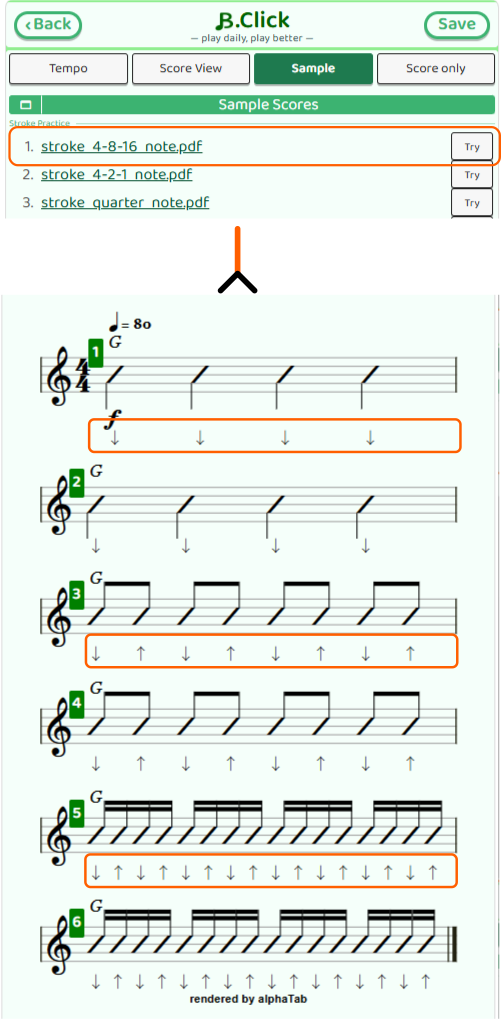
ポイントは、音符が細かくなるほど右手の動きも細かくなることです。4分音符はクリック1回にダウン1回、8分音符はダウン→アップの2回、16分音符はさらに倍の細かさでダウン→アップ→ダウン→アップと弾きます。最初はゆっくりなテンポに設定して、ダウンとアップの間隔が均等になるよう意識してみてください。
楽譜を見ながら試してみよう:4分・2分・全音符
もうひとつ、stroke_4-2-1_note.pdfという練習用楽譜もあります。こちらは4分音符・2分音符・全音符の練習で、すべて↓(ダウン)のストロークです。
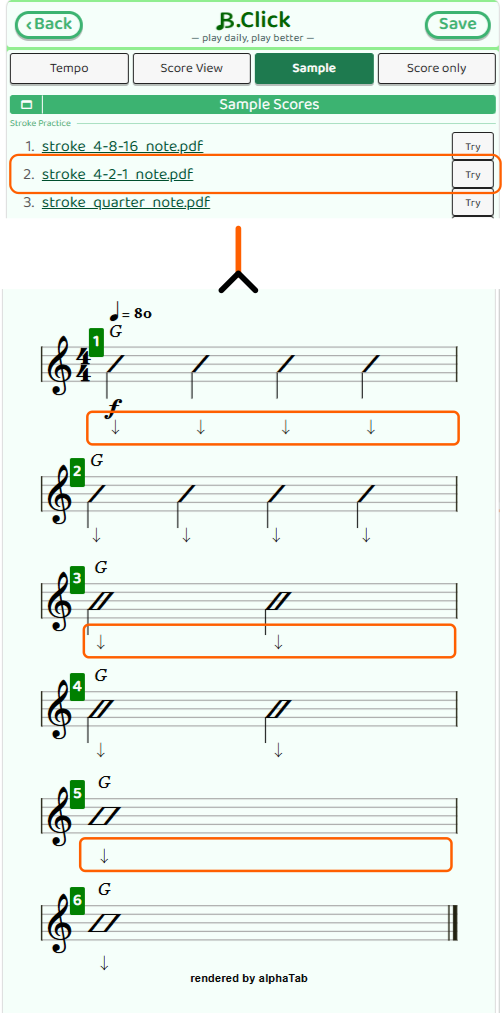
この楽譜では、弾く回数を増やすよりも、音をどれくらい伸ばすかを意識します。4分音符はクリックごとに1回、2分音符は2拍ぶん、全音符は1小節の4拍ぶんを感じながら鳴らします。コードを押さえた音がきれいに続いているか確認する練習にもなります。
Strum Patterns Change the Mood
Once you can press chords and play in time with the tempo, the next step is to change your strum pattern. Even with the same chord progression, the feel of a song can change dramatically depending on how detailed the strumming is and how the rhythms are combined.
Quarter Notes (Downstrokes Only)
One downstroke per click. This is the simplest shape and the basic pattern you have already used in earlier practice. It creates a relaxed feel.
Eighth Notes (Down + Up)
Two strokes per click: down then up. This is twice as detailed as quarter notes, so the rhythm feels a little busier. Try to keep the downstrokes and upstrokes evenly spaced.
Sixteenth Notes (Down→Up→Down→Up)
Four strokes per click. This creates an even more detailed rhythm. Start with a slow tempo and focus on keeping your hand movement even.
Mixed Patterns
Combining quarter notes, eighth notes, and sixteenth notes within one measure creates more expression in the rhythm. For example, you might play only downstrokes for the first two beats, then down-up strums for the last two beats. Adding this kind of variation makes your playing more musical.
Whole Notes and Half Notes
You can also play patterns where you strum once and let the sound ring for 4 beats (whole note) or 2 beats (half note). This is also good practice for pressing the chord firmly and making it sound clean.
Try It with a Score: Quarter, Eighth, and Sixteenth Notes
B.Click includes a practice score called stroke_4-8-16_note.pdf in the sample scores. It places quarter-note, eighth-note, and sixteenth-note strums in order, and shows how to play them with ↓ (down) and ↑ (up) arrows.
The key point is that as the notes get shorter, your right-hand movement also becomes more detailed. Quarter notes are one downstroke per click, eighth notes are down then up, and sixteenth notes are twice as detailed again: down, up, down, up. Set a slow tempo at first and focus on keeping the spacing between downstrokes and upstrokes even.
Try It with a Score: Quarter, Half, and Whole Notes
There is another practice score called stroke_4-2-1_note.pdf. This one is for quarter notes, half notes, and whole notes, and all the strokes are ↓ (down) strokes.
With this score, focus less on increasing the number of strokes and more on how long the sound continues. Quarter notes are played once per click, half notes are held for 2 beats, and whole notes are held for all 4 beats of one measure. This is also useful for checking whether the chord sound continues cleanly after you strum.
Los patrones de rasgueo cambian el ambiente
Cuando ya puedes pulsar acordes y tocar siguiendo el tempo, el siguiente paso es cambiar el patrón de rasgueo. Incluso con la misma progresión de acordes, el ambiente de una canción puede cambiar mucho según lo detallado que sea el rasgueo y cómo combines los ritmos.
Negras (solo golpes hacia abajo)
Un golpe hacia abajo por cada clic. Es la forma más sencilla y el patrón básico que ya has usado en las prácticas anteriores. Crea una sensación tranquila.
Corcheas (abajo + arriba)
Dos rasgueos por cada clic: abajo y luego arriba. Es el doble de detallado que las negras, así que el ritmo se siente un poco más animado. Intenta que los golpes hacia abajo y hacia arriba queden a una distancia uniforme.
Semicorcheas (abajo→arriba→abajo→arriba)
Cuatro rasgueos por cada clic. El ritmo se vuelve todavía más detallado. Al principio, practica con un tempo lento y concéntrate en mantener uniforme el movimiento de la mano.
Patrones mixtos
Combinar negras, corcheas y semicorcheas dentro de un mismo compás crea más expresión en el ritmo. Por ejemplo, puedes tocar solo golpes hacia abajo en los dos primeros tiempos, y abajo-arriba en los dos últimos. Añadir este tipo de variación hace que la interpretación suene más musical.
Redondas y blancas
También hay patrones en los que rasgueas una sola vez y dejas sonar el acorde durante 4 tiempos (redonda) o 2 tiempos (blanca). Esto también sirve para practicar que el acorde esté bien pulsado y suene limpio.
Pruébalo con una partitura: negras, corcheas y semicorcheas
B.Click incluye una partitura de práctica llamada stroke_4-8-16_note.pdf entre las partituras de ejemplo. En ella aparecen rasgueos de negras, corcheas y semicorcheas en orden, y las flechas ↓ (abajo) y ↑ (arriba) indican cómo tocarlos.
El punto importante es que, cuanto más cortas son las notas, más detallado se vuelve también el movimiento de la mano derecha. Las negras son un golpe hacia abajo por clic, las corcheas son abajo-arriba, y las semicorcheas son el doble de detalladas: abajo-arriba-abajo-arriba. Empieza con un tempo lento e intenta que la distancia entre los golpes hacia abajo y hacia arriba sea uniforme.
Pruébalo con una partitura: negras, blancas y redondas
También hay otra partitura de práctica llamada stroke_4-2-1_note.pdf. Esta sirve para practicar negras, blancas y redondas, y todos los rasgueos son ↓ (abajo).
En esta partitura, más que aumentar la cantidad de rasgueos, presta atención a cuánto tiempo mantienes el sonido. Las negras se tocan una vez por clic, las blancas duran 2 tiempos y las redondas duran los 4 tiempos de un compás. También es una buena práctica para comprobar si el sonido del acorde continúa limpio después de rasguear.